
Enzymes Kinetic Studies

Enzymes are protein catalysts to speed up the rate of a chemical reaction without being used up in the process. The study of the rate at which an enzyme works is called enzyme kinetics.
Kinetic information is useful for examining possible mechanisms for the reaction and to understand both catalyzed and non-catalyzed reactions. Enzyme kinetics is a mathematical description observed by reaction rate (v) denoted through Vmax and Km (Michaelis constant Km is the concentration at which the rate of the enzyme reaction is half Vmax). Diseases and disorders often involve alterations in enzymes or enzyme activities.
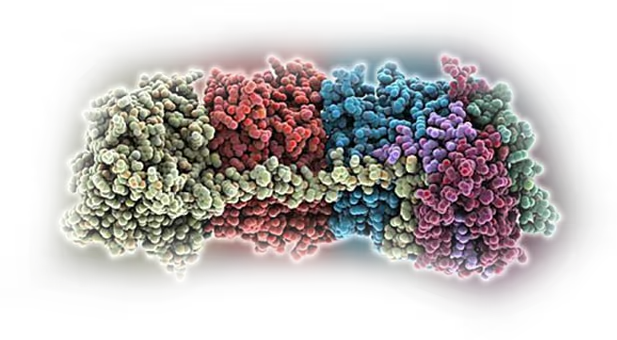
For enzymes, kinetic information is useful for understanding pathological states. Diseases and disorders often involve alterations in enzymes or enzyme activities.
Understanding the way that enzymes work is critical for understanding how drugs work because many drugs function by interacting with enzymes.
Discover our areas of work

Genotoxicity Studies
Genotoxicity studies can be defined as various in vitro and in vivo tests
Cytotoxicity Studies
Cytotoxicity is the quality of being toxic to cells which could be a chemical

Gene expression studies
Gene expression is a highly regulated mechanism that controls the function.