CCMB

Overview
The focus of Microbial biotechnology team in VMRC is on strain bank collection, screening bacterial cultures, finding the reason for resistance, which resistances co-exist, study genetic level influence of antibiotic resistance breakers (ARBs), to study how resistance emerges and disseminates and finding solution for Antimicrobial Resistance (AMR) for better public health.
AMR poses a global health crisis wherein common and treatable infections have been becoming life-threatening due to the emergence of bacterial resistance either through mutations in the genome or by horizontal gene transfer (HGT). Multi-drug Resistance (MDR) strains have become widespread both in hospitals and the community, in all WHO regions, therefore, the development of new drugs or reviving the life of existing drugs using ARBsis of critical importance.
Besides this team also has expertise in animal cell culture, molecular biology, protein biochemistry and enzymology, enzyme kinetic study, Enzyme Linked Immuno Sorbent Assay (ELISA), biochemical analysis, gene expression study, biophysical analyses, and protein purification and expression, mutagenicity assay. The results of these studies have implications in the fields of drug development. In brief, the whole area of work can be divided into parts:
- Antibiotic resistance breakers (ARBs)
- Antibiotics and antibiotic resistance
Antibiotic resistance breakers
These are usually nonantibiotic compounds, that in combination with antibiotics enhance the antimicrobial activity of the antibiotics. ARBs can function either by reversing resistance mechanisms in naturally sensitive pathogens or by sensitizing intrinsic resistant strains.
ARBs can be divided into two groups: Class I agents that act on the pathogen, and Class II agents that act on the host. Class I ARBs acting on pathogens may potentiate antibiotic activity by affecting a vital physiological bacterial function, but potentiation of antibiotic activity can also occur by (i) inhibition of antibiotic resistance elements; (ii) enhancement of the uptake of the antibiotic through the bacterial membrane; (iii) direct blocking of efflux pumps; and (iv) changing the physiology of resistant cells (i.e. dispersal of biofilms to planktonic cells which are more susceptible to antibiotics).
Another kind of ARBs (class II) acts as an immune-potentiators (facilitating Signals 2 and 3) exhibiting immune stimulatory effects during antigen presentation by inducing the expression of co-stimulatory molecules on APC. Together, these signals determine the strength of activation of specific T-cells, thereby also influencing the quality of the downstream T helper cytokine profiles and the differentiation of antigen-specific T helper populations (Signal 3)
The strategies explored in my group for ARBs screening include:
- Identification of ARBs with reduced toxicity and high Cmax values
- Combination screening of potential ARBs and antibiotics
- To evaluate dose-response and checkerboard combination analysis
- To study the critical concentration of ARBs
- To elucidate the mode of action of these ARBs
Antibiotics and antibiotic resistance
Any substance that inhibits the growth and replication of a bacterium or kills it is called an antibiotic. Antibiotics are a type of antimicrobial designed to target bacterial infections within (or on) the body. There are two main ways by which antibiotics target bacteria. They either prevent the reproduction of bacteria, or they kill the bacteria, Antibiotic resistance happens when germs like bacteria and fungi develop the ability to defeat the drugs designed to kill them. That means the germs are not killed and continue to grow. It is rising to dangerously high levels in all parts of the world. New resistance mechanisms are emerging and spreading globally, threatening our ability to treat common infectious diseases. There are different distinctive mechanisms of antibiotic resistance by which bacteria get resistant towards antibiotics: beta-lactamases production, decreased permeability, target alterations, biofilm development, over expression of efflux pumps, etc.
The strategies adopted in our group to overcome antibiotic resistance include:
- To study various resistance mechanisms such as beta-lactamases (ESBLs & MBLs) production, biofilm development, membrane permeability alterations, horizontal gene transfer (HGT), efflux pump, binding site modification, protein modification, Corum sensing, including involved in antibiotic resistance
- To study concomitant virulence of multi-drug resistant bacteria at the molecular level
- To study fractional inhibitory concentration using checkerboard
- To study mutant prevention concentration
- Post-antibiotic effect (PAE)
- To study differential gene expression
- To study enzyme kinetics of ESBLs and MBLs
- To study non-clinical infection models, including PK-PD and PDT analyses
- To study in vitro and in vivo models and to unravel new strategies to overcome infectious diseases
Business Strategy

Dr. Anurag Payasi
Shailesh Kumar

Contact at: ccmb@vmrcindia.com
Recently Published Work
Pharmacodynamic Assessment of VRT001-C (Oral Ceftriaxone) vs. IV Ceftriaxone Against Escherichia coli in the Neutropenic Murine Thigh Infection Model
presented at the 29th ECCMID, the European Congress of Clinical Microbiology and Infectious Diseases, which took place in Amsterdam, Netherlands, 13 – 16 April 2019.
Payasi A, Ganguly K, Roy D, Sachdeva A, Chaudhary M, Chaudhary S, Aggarwal A. Poster number L0029
Ceftriaxone-Sulbactam-EDTA vs. Meropenem in PLEA (a Phase 3, Randomized, Double-blind Trial): Outcomes by Baseline MIC in Adults with Complicated Urinary Tract Infections or Acute Pyelonephritis
presented at IDWeeK-2018, October 3-7, 2018 at the Moscone Convention Center, in San Francisco, CA.
Mandela P, Mir MA, Chaudhary S, Chaudhary M, Sood R, Patil NS, Narang S, Payasi A, Shameem M, et al. Poster number 1974
The activity of Ceftriaxone-Sulbactam-EDTA Against Multi-Drug Resistant A. baumannii, P. aeruginosa and Enterobacteriaceae Isolates (WHO Critical Priority Pathogens) Collected from Various Hospitals in India
presented at IDWeeK-2018, October 3-7, 2018 at the Moscone Convention Center, in San Francisco, CA
Girotra R, Payasi A, Chaudhary M, Patil NS, Mir MA, Chaudhary S, Mandale P, et al. Poster number 1373
Ceftriaxone-Sulbactam-EDTA vs. Meropenem: Analysis of failed patients with an assessment of MIC increases and changes in genotypic profile in PLEA (a Phase 3, Randomized, Double-blind Clinical Trial in Adults with Complicated Urinary Tract Infections or Acute Pyelonephritis)
presented at IDWeeK-2018, October 3-7, 2018 at the Moscone Convention Center, in San Francisco, CA.
Mir MA, Chaudhary S, Chaudhary M, Payasi A, Patil NS, Mandale P, Girotra R, Fatima N, et al. Poster number 1948
Antimicrobial Resistance in India - Genotypic Characterization and Exploring the Role of EDTA as an Antibiotic Resistance Break
presented at ASM/ESCMID conference on drug development to meet the challenges of antimicrobial resistance September 6-8, 2017 in Boston, MA.
Chaudhary M, Payasi A, Patil S. Poster number 192
Discover our areas of work
ARB
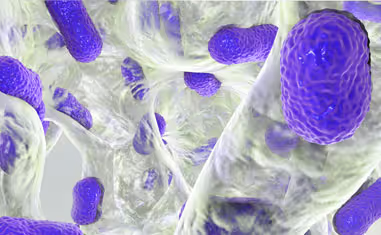
ARBs offer a means to both suppress the emergence of resistance

Genotoxicity Studies
Genotoxicity studies can be defined as various in vitro and in vivo tests
Cytotoxicity Studies
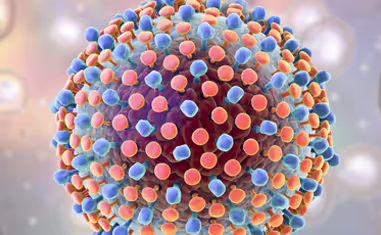
Cytotoxicity is the quality of being toxic to cells which could be a chemical

Gene expression studies
Gene expression is a highly regulated mechanism that controls the function.

Enzyme kinetic studies
Enzymes are protein catalysts that, like all catalysts, speed up the rate.